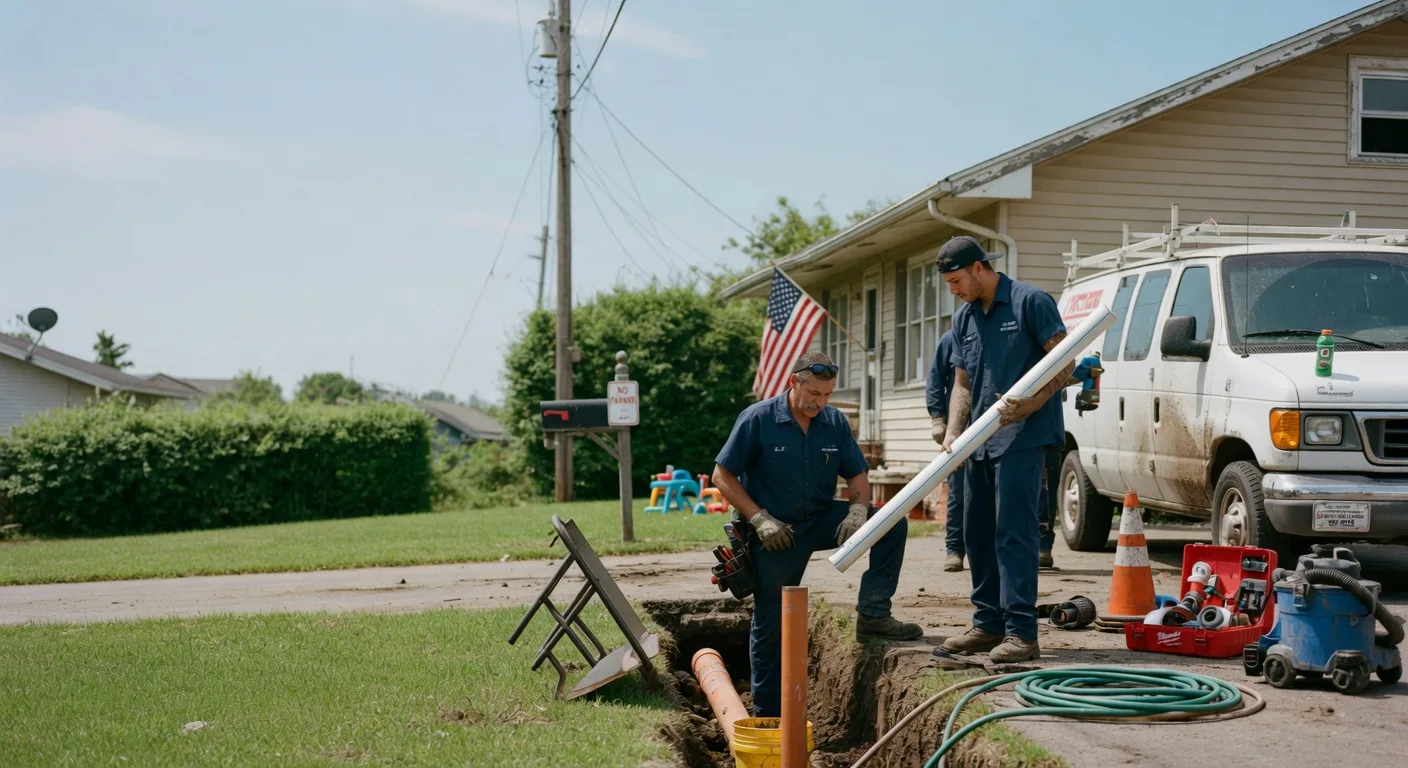
When is a drain backup a plumbing emergency?
Stop running water and call now if water is backing up from more than one drain, sewage is coming up through a floor drain or tub, a toilet overflows on its own, or you smell sewer gas inside the house. Those signs point to a blocked or failed main line. That is a different problem from one slow sink. The main line carries everything the house sends out, so when it stops, water has only one place to go, which is back up through the lowest opening in the house, usually a basement floor drain or a tub. Every load of laundry, dishwasher cycle, or shower adds to the flood, so turning off water use is the most useful thing you can do while you wait. Do not try to clear a full main line yourself; it takes a larger cable or a jetter, and sewage carries bacteria. Keep children and pets out of the affected area. A single slow drain that still empties, or a fixture that gurgles once in a while, can usually wait for a scheduled visit. A backup that is rising, spreading, or coming from several places cannot. Call (380) 262-9173 to be connected with an independent plumber in Bridgeton, NJ.
If you decide the situation is serious, a few quick actions will limit the damage. Shut off the washing machine and dishwasher, and ask everyone to hold off on flushing. If water is already on the floor, lift rugs and move belongings out of the way, and keep electrical items and cords clear of wet areas. Do not run a wet vacuum on sewage, and do not wade through it barefoot. Take photos of the water and the affected fixtures, since they help if you later need to describe the problem to an insurer. Open a window for ventilation if the smell is strong. Know where your main water shutoff is, because if a supply line is leaking rather than a drain backing up, that valve is the right one to close. Older homes often have a floor drain that is the first place sewage appears, so check it first.
Can my downspouts or sump pump cause a sewage backup?
Every drain is gurgling and dirty water comes up the basement floor drain, but only when it rains. That is not one slow sink. Storm water is a prime suspect.
In older housing stock, gutters, a yard drain or a sump pump discharge were sometimes plumbed straight into the sanitary sewer. In a storm, all that extra water floods the house lateral and the municipal main. The pipe runs full, so sewage is pushed back up the lowest opening: a floor drain, a basement shower, a laundry standpipe.
Many jurisdictions now prohibit this. Disconnecting it is often a permit or code matter.
Safe homeowner check: walk the outside of the house. See where each downspout ends. Does it spill onto the ground, or vanish into a pipe in the soil? Does the sump pump discharge run out to daylight, away from the foundation, or into a pipe tied to the house drain? Look only. Do not dig.
Stop running water and call now if more than one fixture is backing up, if sewage is rising, or if it is reaching the floor. A single slow sink is a different job, and a cable machine usually handles it. A storm-driven backup is not a clog, so cabling will not cure it.
A plumber finds the connection with a camera inspection, which shows a tie-in on the pipe, or a dye test, where colored water poured into a downspout or sump shows up in the sewer. What the work involves depends on access, the materials, how much has to be opened up, and any permit requirement.
Expert Plumbers Co is a referral service. We refer homeowners in Bridgeton, NJ to an independent local plumber for Drain Cleaning and Emergency Drain Cleaning. Call (380) 262-9173.
Once the connection is found, the usual fix redirects the storm water instead of changing the sewer. Downspouts can be extended to discharge onto the ground well away from the foundation, with the soil graded to carry water off. A sump discharge should run outdoors to daylight or to a drainage point that local code accepts.
A common mistake is capping the old pipe at the wall and leaving the buried tie-in open to the sewer. An open stub can still admit soil, roots and water. Ask the plumber to confirm the old connection is sealed at the sewer end, not just hidden from view.
Sump pumps run hardest during the very storms that load the sewer, so a pump that cycles constantly is worth mentioning on the call. After the change, watch the next heavy rain. The floor drain should stay quiet. If it still gurgles, the cause may be the street main or a damaged lateral, not the tie-in.
What should I tell the plumber on the phone so the right equipment turns up?
Describe what the water is doing and how often it has happened. Those two details decide which tool is needed.
When you call Expert Plumbers Co, a referral service, we ask the same questions. The answers shape the referral to an independent local plumber.
One fixture or every drain? One slow sink is a branch line, and a cable machine often handles it. Every drain backing up points to the main line or a blocked vent stack, which is a bigger job.
Is water rising, or just slow? Rising water means the line is nearly shut. Say so first.
Does anything gurgle when another fixture runs? Gurgling suggests a blocked vent stack or a partial blockage in the main line.
How long has it been happening, and has it been cleared before? A repeat blockage points to a fixed fault, such as root intrusion at a clay joint or a bellied line holding water. Another cable run only buys time. That is a camera inspection case.
Is there a cleanout, and roughly where? Access changes how the equipment gets in.
What is the pipe made of, and how old is the house? In older housing stock, clay and cast iron are common. Clay joints let roots in. Cast iron can scale up inside.
Septic tank or city sewer? A septic system changes where the problem can sit and which tool is safe to use.
Basement or slab? A basement often gives a lower access point. A slab can mean opening the floor or working from outside.
What the work involves depends on access, the pipe materials, how much has to be opened up and any permit or code requirement. Call (380) 262-9173 and we will refer you to an independent local plumber in Bridgeton, NJ.
Have a few practical things ready before the plumber arrives. Clear a path to the cleanout, the basement or the crawlspace, and move stored items out of the way. Know where the main water shutoff is and be ready to show it.
If you can, take a short phone video of the symptom, such as water rising in a tub when the washer drains. Intermittent problems often vanish by the time anyone arrives, and a video shows what the water was doing.
Mention anything poured down the drain recently, including chemical cleaners. Those affect which tools can be used safely, and the plumber needs to know before reaching into the line.
Say if pets or small children are in the home, and keep your phone nearby, because the plumber may call to confirm the address and access details. Answers ready on the first call shorten the visit and help the right equipment arrive the first time.
My bathroom sink drains slowly but the stopper is clean. What else could it be?
If you have pulled the stopper and cleaned off the hair and soap film and the sink still drains slowly, the restriction is further down. The stopper mechanism is only the first few inches. Most of the slowdown lives in the pivot rod area, the tailpiece, the trap, or the pipe beyond it.
The common cause is a layer of soap scum, toothpaste and hair that binds together on the pipe wall. It narrows the pipe a little each month, and the sink slows long before it stops.
Safe checks you can do: set a bucket under the sink and unscrew the trap. Clear out what you find and rinse it. Look at the short pipe going into the wall for build-up you can reach with a bottle brush. Fill the basin and let it run, then watch whether the water drains evenly or with a gurgle. Skip chemical cleaners, which can soften plastic fittings and leave caustic liquid sitting in the trap.
Gurgling is a clue. A sink that drains slowly and gurgles can point to a blocked vent, because the drain cannot pull air behind the water. If the toilet or shower near that sink also acts up, the blockage may be in the shared branch line or the main drain, not the sink itself.
One slow sink with everything else normal usually means a local clog, and a cable machine through the trap arm is enough. If the pipe clears and slows again within a few weeks, a camera inspection can show whether the pipe wall is scaled over or has a sag that holds water. Heavy scale or soap buildup in the branch line may call for hydro jetting.
Call and stop using the sink if you see water leaking from the trap or the wall, if sewage smells from the drain, or if several drains in the house slow at once. That pattern usually means the main line is partly blocked.
Cost depends on how easy the pipe is to reach, whether the cleanout is nearby, how far the plumber must run the cable, and whether any worn pipe has to be replaced.
Expert Plumbers Co can connect you with an independent local plumber in Bridgeton, NJ when you call (380) 262-9173.
What actually happens when a plumber comes to clear my drain, from the moment he arrives to the last flush?
Most people only see the machine come out of the truck. There is more to the visit than that, and knowing the order helps you tell a careful job from a rushed one.
An independent plumber usually starts with questions. Which fixtures are slow, which are fine, when it started, and whether you have noticed gurgling or a smell. One slow sink points to a branch line. Every drain in the house acting up points to the main line.
Next comes a look at access. That might be a sink trap, a tub drain, a toilet that has to be pulled, or a cleanout outside or in the basement. Floors and cabinets get covered with towels or a drop cloth.
Then the plumber picks the tool. A hand auger or small drum machine suits a sink or shower. A larger cable machine suits a main line. If grease or heavy scale is suspected, hydro jetting may come up instead, and a camera may be suggested before anything else.
The cable goes in and is fed forward by feel. A clog gives resistance, then a change when the cutting head breaks through. Roots, grease and soft paper each feel different, and a careful plumber will tell you what the cable seemed to hit. When the cable comes back out, whatever clings to it is worth a look. Hair, wipe fibers, root hairs or a greasy paste all point to a cause.
After that comes the test flush. Water runs through the fixture, and often through several fixtures at once, while the plumber watches for slow movement, gurgling, or water rising in a neighboring drain. At a cleanout, the plumber watches the flow pass. This step matters most. A line that drains well for ten seconds and then slows is only partly open.
Last, the plumber explains what was found. If the blockage was in the main line, has come back before, or the cable stopped at the same spot each time, a camera inspection is the sensible next step, because a cleared pipe and a healthy pipe are not the same thing.
Cost depends on access, how far the cable has to travel, whether a toilet has to be pulled, and whether extra equipment is needed.
If you need a drain cleared in Bridgeton, NJ, Expert Plumbers Co can connect you with an independent local plumber at (380) 262-9173.